🎙️Transcript: The EngiNerd Life
The EngiNerd Life
"You're Not Hiring Talent, You're Building a Tree"
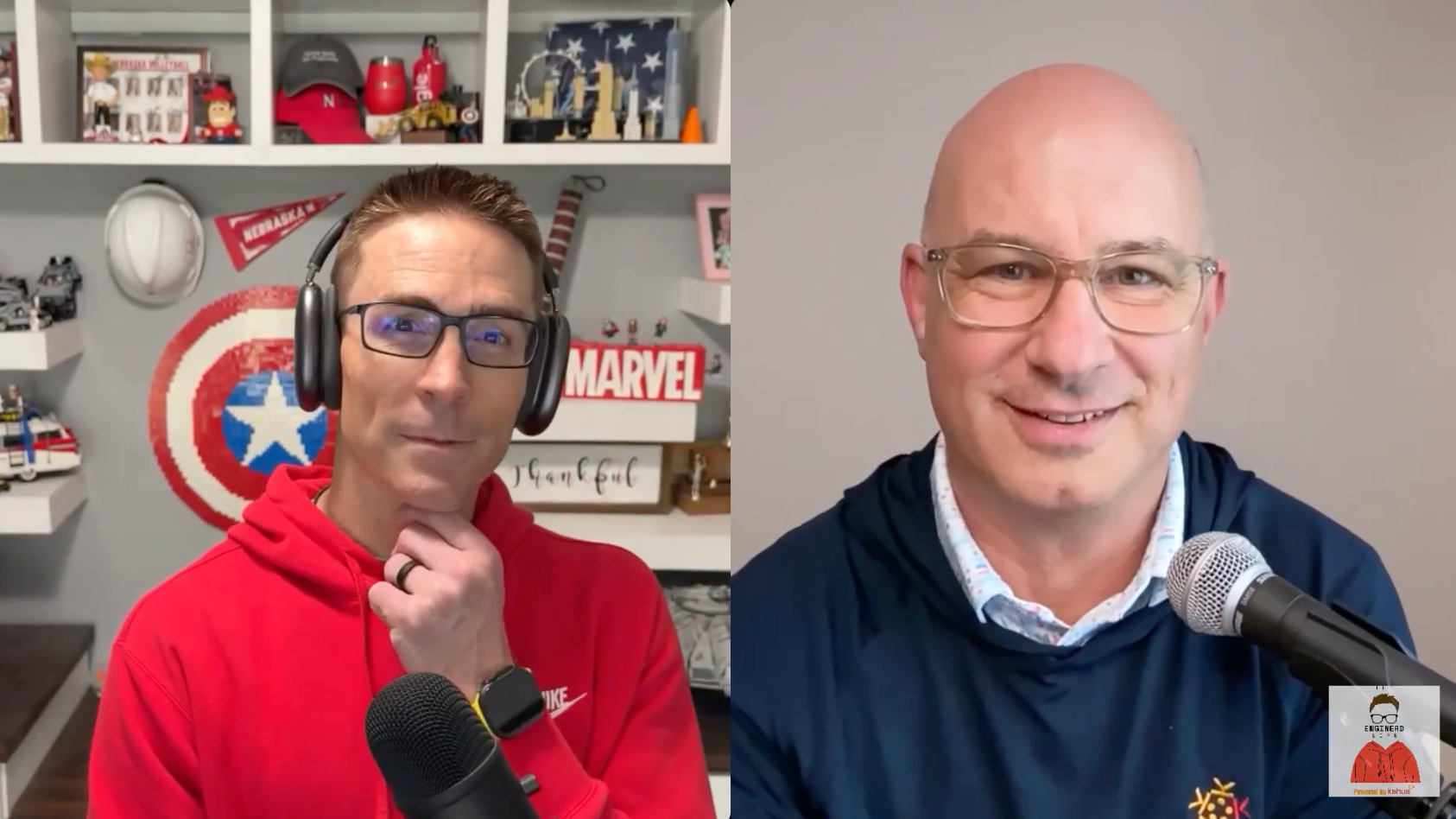
AJ Waters, Ralph Barsi
May 26, 2026
🎧 Hear on Spotify
🎧 Hear on Apple
📺 Watch on YouTube
Summary
Ralph Barsi joins AJ Waters on The EngiNerd Life to unpack his superpower: building teams that consistently outperform. He traces it back to UPS founder Jim Casey's teachings, John Wooden, and Bill Walsh's The Score Takes Care of Itself.
The core thesis is people first; know which way north is and why, serve from the bottom of the org chart, and trust the systems that turn goals into repeatable results.
He reflects on scaling ServiceNow's global sales development org from 75 to 230+ people while the company grew from $1B to $4B, where "plan the work, work the plan" carried the weight.
He closes on construction's labor and leadership gap, arguing that developing strong leaders is the breadcrumb trail the next generation will follow.
BIG Takeaways
Culture and strategy aren't rivals; they're partners. A pushback on Drucker's "culture eats strategy." Strategy is the road map, north. Culture is the engine that gets everyone there. One without the other strands you.
The linchpin is the leader, not the roster. A bad leader at the helm bleeds out dozens of good people. People don't leave organizations; they leave leaders. Hire A-player leaders first, then everything downstream gets easier.
You scale by doing the things that don't scale. Get on the plane. Sit across the table. Know your people's backgrounds, families, career arcs. Proximity is power, and small two-degree tweaks put the train back on the track.
Great leaders are great writers, because great writers are great thinkers. The daily habit that separates A-players: writing out what the perfect day looks like, thinking it through, then delivering it to the team. The presentation is just the manifestation.
Transcript
AJ: Welcome back to The EngiNerd Life, the show about the future of construction without all the fancy buzzwords. We have honest, human, and practical conversations about what's working, what isn't, and what we're all still trying to figure out.
AJ: Each episode, we sit down with someone who has a unique superpower they're using to make the industry better. Today I'm joined by the one and only Ralph Barsi of Kahua. Ralph has a great background, from rock and roll to business development.
AJ: His superpower is building and developing high-performing teams, which holds up across industries. Every step along the way, Ralph has taken this rare ability to build teams that consistently outperform. It's a pleasure to have you on the show, Ralph.
Ralph: AJ, the pleasure is mine. That's a kind, humbling intro. Thank you for having me.
AJ: Everyone who's been in the game a while has one of those moments where everything clicks. Looking back across all the stops in your career, what was the one moment that fundamentally changed how you thought about developing teams?
Ralph: It would have to be the start of my career. I began in early 1994 at United Parcel Service, and right out of the gate we were immersed in the philosophies of UPS's late founder, Jim Casey.
Ralph: Jim had recorded and transcribed all the talks he and his leaders gave at conferences, executive luncheons, and company events. Those were compiled into a four-book series titled Our Partnership Legacy. You can probably still find them on eBay.
Ralph: Those books underpinned the teachings of my formative years, trust, culture, leadership, determination, integrity, all the core values that probably still drive UPS today. Those are my earliest memories of starting to form that mindset about work.
AJ: That's consuming leadership-focused content. What about being around an individual? Was there a particular leader early on who shaped your view on developing talent?
Ralph: It's tough to pinpoint one; there were several. I spent time at a company called Achievers, whose offering centered on employee engagement. The leader I worked with and for there was very encouraging about learning and development.
Ralph: He always encouraged us to set aside time and even a budget to learn on our own, beyond what the company subsidized. It got me into the habit of carving out a set number of dollars each year for my own development; seminars, online courses, certifications, and so on.
Ralph: That carried into my years at ServiceNow. I was supported when I raised the chance to get certified at UC Berkeley's School of Business. They had an incredible course for younger leaders on executive decision-making, and nobody flinched. I can't thank them enough.
Ralph: Then there are the leaders I didn't work for. I'm a big reader. A few examples include the late UCLA coach John Wooden's book, Wooden on Leadership. The same co-author, Steve Jamison, also worked with the late 49ers coach Bill Walsh on The Score Takes Care of Itself.
Ralph: It was books like that, leaders like that, courses and experiences like that, that I remember fondly.
AJ: A lot of that is individual-focused, because you took ownership of your own development. But I believe the key difference between an average company and a great one is the culture around it, not just strategy. You often hear, culture eats strategy for breakfast. Do you agree?
Ralph: That's a classic, a Peter Drucker line, and a good one. But I'd push back slightly on the framing. I don't think culture and strategy are competing forces. They need each other and have to work together.
Ralph: I liken strategy to the road map. Which way is north? That's all strategy. Culture is the engine that gets us all there. They need each other. I understand where Peter was coming from, but I don't think they're necessarily competing.
AJ: I love that. You've got the GPS and the engine. You won't go anywhere without fuel, but with fuel and no direction you end up somewhere random.
Ralph: Exactly.
AJ: One interesting thing about your superpower is that you don't just develop great people, you create environments where they grow faster than they would elsewhere. What's a key environmental difference between a group of talented people and a high-performing team?
Ralph: First, you're too kind with the superpower talk. I've had the privilege of working for and with incredible leaders. I learned from them and tried to model what I learned in the organizations I serve. If it is a superpower, good; that means it creates more leaders. That's the point.
Ralph: To create the environment, I recall seeing the late Dr. Stephen Covey, author of The 7 Habits of Highly Effective People, at a workshop about 25 years ago. He had everyone stand, cover their eyes with their right hand, and point north with their left.
Ralph: Then he had us drop the right hand, keep the left up, and look around the room. Everyone was pointing all over the place. He said this is what most organizations struggle with. They assume it's a trust or proficiency problem.
Ralph: But the root cause is that everyone thinks they know which way north is, and they don't, or nobody knows, and they're all heading in different directions. I remember that whenever I'm given responsibility to lead a team.
Ralph: First and foremost, I want everyone to know which way north is, and why that way is north. It's not just for our team; we serve a greater ecosystem of partners, prospects, and customers. Without north, it's an uphill climb to find it, let alone get there.
Ralph: A few quotes stick with me. Jim Rohn said each of us needs all of us, and all of us need each of us. There's the proverb: if you want to go fast, go alone; if you want to go far, go together. That's the collective effort toward where you're headed.
Ralph: A third is from Navy SEAL Marcus Luttrell, the Lone Survivor. He said there's a big difference between being on a team and being a team. If you can tell those two apart, you're already part of what we're trying to get done together.
AJ: Let's break down that each-of-us-needs-all-of-us idea. There's the concept of role players, even on sports teams. When you're building a high-performing team, what attributes do you look for? Do some qualities matter more than credentials and experience?
Ralph: One hundred percent. If I can tease out whether they've decided to be a success in their career, I aim for that. I want to know the light switch has flipped, that they've made a decision to be successful, to add value, and to be a true teammate.
Ralph: I look for whether that switch is already on. Second, I look for a service mindset. We're here to serve others. Especially when hiring leaders, I want a leader who sees themselves at the bottom of the org chart, not the top.
Ralph: Their job is to serve and support their team, to identify and remove obstacles from their direct reports' paths so those people can get where they need to go. That has systemic, positive impact on everyone they engage.
Ralph: It's also critical to establish trust and credibility early with every individual. Another favorite book is Patrick Lencioni's The Five Dysfunctions of a Team. Those are the fundamentals that drive successful teams, over and over, regardless of the era.
Ralph: And you have to communicate. Clearly, concisely, consistently. That keeps everyone on the same page, mitigates risk, and surfaces hurdles coming down the pike so we can avoid them. Those are key characteristics I look for when building a team of A-players.
AJ: That's easy with a handful of people. But you mentioned ServiceNow, where you scaled a well-respected team. When you take a team from a handful of people to a massive one, what matters most? Systems? Culture? Both?
Ralph: Great question, and a tough one. For context, I oversaw the global sales development organization at ServiceNow from 2015 to 2019. The company was just shy of a billion in revenue when I arrived and north of four billion when I left.
Ralph: The team was about 75 people when I joined and north of 230 across 15 offices worldwide when I left. So it's critical to bring in all those traits: deciding to succeed, knowing north, serving others, trusting, communicating clearly and consistently.
Ralph: But at the end of the day, you rely on your systems. Systems trump goals all day long. It's great to know which way north is and what the targets are, but without the systems and processes to get there repeatedly and predictably, it's a big struggle.
Ralph: At ServiceNow, the focus from the top down was always plan the work, work the plan. We had specific approaches to planning the work and executing on it, so we could not just hit goals but exceed them consistently and repeatably.
AJ: Everybody says they want a high-performing team, then finds it tougher than they think. It's also risky to develop people; they could take your spot or jump ship with new skills. Where do organizations struggle when it comes to developing great teams?
Ralph: One key area is that it's tough to coach people who don't want to be coached. If you're not on the team, and not open or vulnerable enough to accept constructive feedback, it gets challenging for everyone, and it causes a ripple effect.
Ralph: If someone won't be coached and has a bad attitude about it, it infiltrates the team and poisons the well. My guidance for anyone struggling: when scaling a team, you have to do the things that don't scale.
Ralph: Overseeing a global team, there's power in proximity. Get on an airplane and sit across the table from your leaders in Europe, South America, or Asia-Pacific. Roll up your sleeves, sit with the teams, understand the real-world challenges they face.
Ralph: Often those challenges aren't insurmountable. It's a matter of little two-degree tweaks by team or by individual, and you get the train back on the track. The real struggle is people who don't want to be coached and bring the rainclouds into the room instead of light and life.
AJ: Let's double-click on that. Is it more difficult to hire the right people, or to get the right leaders in place once those people are hired?
Ralph: No question, the right leaders. That's imperative to the health of the organization. If you have a bad leader at the helm, you risk losing handfuls or dozens of good people who roll up into that leader.
Ralph: There's an old saying: people don't leave organizations, they leave leaders. That brings us back to recruiting and hiring. It's critical to hire A-player leaders, and of course A-player individual contributors too. But the lynchpin, in my opinion, is the leader.
AJ: Relating this to construction, which like sales is performance-driven with tight deadlines, how do you build a culture around high performance and tight timelines without burning people out?
Ralph: Whether it's construction or otherwise, but especially construction, it's reinforcing the purpose and the why of a project or a program. I heard one of your episodes where a guest said we're not just drafting schematics for the calculations.
Ralph: We're building somebody's vision, making it real. If you can tie the workforce back to what we're building and why, who it's for, who benefits, that inherently gets humans back on track and flying in formation. That's what comes to mind in the construction world.
AJ: Focusing on construction specifically, the industry faces mounting people challenges. Too many leaving, not enough coming in; the labor shortage is real. Why do you think the ability to develop teams matters more now than ever for construction?
Ralph: We have generations relying on us. We're the models future generations will learn from and hopefully emulate. Hopefully we're leaving a trail of breadcrumbs for them to pick up. I read recently that over 40 percent of construction workers are projected to retire within 3 to 5 years.
Ralph: That's staggering, and it doesn't even mention the mental health crisis or the evolution of AI happening so fast before our eyes that we're struggling to keep up with the pace of change. That overwhelms a lot of people; maybe a topic for another episode.
Ralph: I'd fall back on leaving behind that trail of breadcrumbs and serving as a good model for the next generations to emulate.
AJ: You mentioned people don't leave organizations, they leave bad leaders. I've also heard your boss has more impact on your mental health than your friends or even your spouse. What impact could it have if we truly developed stronger leaders across the industry?
Ralph: Think about the positive impact on waves of new workers coming in. Going back to The Score Takes Care of Itself, the co-author focused not just on Bill Walsh's coaching style but on the coaches he created, a coaching tree of greats who paid it forward.
Ralph: If it means that much to you to be where you work, you'll pay attention to how your boss responds to you. And if you have the privilege of leading others, they're watching your reaction to gauge how to respond, especially in tough times, rough patches, and crises.
Ralph: If you're calm, cool, and in control, your team likely will be too. I'd go back to Covey: seek first to understand, then to be understood. Actually listen to your team. Gauge how emotion is weighing into a problem they're surfacing. Get to know your people individually.
Ralph: Back to the stuff that doesn't scale being how you scale. Learn their background as much as they'll share. What's their family like? Where did they grow up? Where are they on their career arc, so you can help them get where they need to go?
Ralph: You'll also understand what might be bugging them on a given day or quarter. All of that counts, and it lets them pay it forward when they get the chance to lead others.
AJ: Sticking with the athletic analogy, you mentioned Walsh's coaching tree. We've also seen coaches famous for building programs that lasted decades. Coming from Nebraska, Tom Osborne is one I relate to. Does something change when organizations invest in developing people over buying experience?
Ralph: Yes. What changes is they become an iconic company, brand, or environment, and they leave behind a legacy. It's not a one-off win. You're playing the long game, and you're not so much pursuing top talent as attracting it by being who you are.
Ralph: Your reputation precedes you one way or the other, good or bad. You might as well double down on crafting a great reputation, so you attract top talent who know about you before they arrive and want to contribute to what you're building.
Ralph: They understand that future generations behind them will want to represent well too. Keep that in mind. That's my take on the impact that kind of leadership can have.
AJ: I could talk about developing people forever; it's one of my favorite things. Especially in construction, which has historically had the perception of not being good at it; yell, loud, tough. Let's get practical.
AJ: If I'm a listener managing a project team, a department, or a small group, what's one thing I could do tomorrow to start developing that team a little better?
Ralph: I'd feed them material that educates them on the issues and trends coming down the pike, or facing your company, team, or industry right now, along with a prescription of how people are overcoming them and still hitting their goals.
Ralph: I'd also reframe or revisit the plan. Plan the work, work the plan. There are two quick ways to frame a solid plan. One looks like an org chart, but it starts at the very top with the answer you're trying to achieve, short-term goal, long-term goal, or company initiative.
Ralph: What's the answer, and what's the purpose behind it? As you cascade the chart, identify the two or three metrics that tell you you're getting there, how you'll monitor progress, and the three or four systems and processes to put in place now.
Ralph: Lastly, what incremental budget or how many heads do you need to achieve the answer? That's one quick way. Another is a plan on a page. Identify owners for specific initiatives and develop SMART goals: specific, measurable, actionable, relevant, and time-bound.
AJ: Relevant and time-bound, thank you.
Ralph: Create SMART goals for each initiative and set a cadence to track how you're heading north, why, and who's leading the charge. Combine a plan plus a purpose plus information on what's going on, and you'll be on the right foot.
Ralph: It's not a herculean effort. You can start tomorrow and have those three pillars in place by end of day. You'll be humming before you know it.
AJ: That helps develop the team. What about me as a leader individually? I won't lead the witness, since you've mentioned several books. Is there a simple daily habit you see in great leaders that average leaders overlook?
Ralph: Yes. In my experience, great leaders are great writers, and great writers are great thinkers. A leader who, on a daily basis, writes out what the perfect day looks like for their organization, and what pieces need to fall into place, is a game-changer.
Ralph: Then they articulate the key thoughts with the team. I've seen A-player leaders do that over and over. When they present to the team, it's simply a manifestation of what they've already written, thought through, and framed in their minds before delivering a charter.
AJ: That's awesome. Ralph, I can't thank you enough. This episode is full of great tips and one-liners from your experience, and the relevance to construction, even where it was tangential to your career. Thank you for coming on.
Ralph: Thank you, AJ. Thanks for making this podcast available to all of us. We learn a lot from you. Keep carrying on.
AJ: If this conversation resonated, take one of Ralph's tips and execute it on your team. See how people respond. If you enjoyed the episode, please rate, review, subscribe, or share it with a friend who cares about the future of construction. Construction is cool. Go tell your friends.
AJ: Thanks, Ralph.
Ralph: Thanks, AJ.