🎙️Transcript: Cracker Jack
XANT
"How to Build a Cracker Jack Sales Development Team in 5 Steps"
Ralph Barsi
December 11, 2017
Summary
In this energizing Sales Development Summit presentation, Ralph Barsi delivers a master class on building what he calls a "Cracker Jack" sales development team using a deliberately unconventional term chosen specifically to capture attention through Neil Patel's headline-writing principles.
Drawing on his experience overseeing 11 offices worldwide at ServiceNow and his 25 years in sales (split evenly between individual contributor and leadership roles), Ralph emphasizes that the same principles apply whether you're attracting talent, crafting compelling job descriptions, or teaching SDRs to write powerful email subject lines: you need a powerful brand and reputation that precedes you.
His opening sets the tone by acknowledging the incredible wisdom being shared at the summit by leaders he himself learns from regularly through their tweets, books, conference presentations, and LinkedIn posts, positioning continuous learning as foundational to sales development excellence.
Ralph's five-step framework begins with attracting A players rather than pursuing them, recognizing that what you seek is also seeking you.
He challenges leaders to examine how strong their personal brand is in the marketplace, whether job descriptions are compelling or generic, and whether they're creating recruiting assets like dedicated webpages with video testimonials from current and former SDRs.
The framework progresses through driving strong employee culture (where people are celebrated not tolerated), communicating well and teaching mastery (recognizing that different cultures and geographies require different approaches to email length, touch cadence, and relationship building), and culminates in serving others.
Ralph positions the sales development function as the knot on a tug-of-war rope serving multiple masters: marketing, sales, partners, and countless stakeholders across demand gen, campaign marketing, solutions consulting, and customer success.
Throughout the presentation, Ralph weaves in tactical advice grounded in real experience: hosting $500 recruiting events that yield top candidates, creating power hours where SDRs make calls in front of peers for constructive feedback, tailoring SLAs based on geographic norms (eight to ten touches over 20 days works in the US but can alienate prospects in Japan or Australia for 18 to 24 months), and conducting one-on-ones outside the office focused on what SDRs are becoming rather than just metrics.
His insistence that sales development leaders should carry a bag themselves and close business before leading gives him credibility when implementing service level agreements or addressing AE-SDR handoff challenges.
The underlying philosophy is systems over goals, servant leadership over hierarchical command, and mastering fundamentals that will serve SDRs throughout their 20+ year careers whether they become account executives, team leaders, or business owners.
BIG Takeaways
• Attract A Players Rather Than Pursue Them (What You Seek Is Also Seeking You) – Ralph emphasizes the critical distinction between attracting versus pursuing talent, arguing that the best people want to learn from and improve their craft under certain leaders.
If candidates aren't applying to your job descriptions, it's likely because they don't know who you are or can't find compelling information about you when they research the hiring manager.
Leaders must prioritize building their brand and reputation in the marketplace through conference presentations, LinkedIn posts, articles, and videos so prospects say "I love what she's saying, I want to learn from that person." The job description itself must break from generic templates (Ralph suggests hiring freelancers through Upwork to analyze the top 50 to 100 SDR job descriptions and then doing something completely different).
Effective job descriptions articulate the two-way street: SDRs invest time and energy finding prospects and creating meetings to kickstart sales cycles while the organization invests time, effort, money, and resources in developing their careers.
Additional attraction strategies include creating dedicated sales development webpages with one-minute videos featuring current SDRs discussing their learning and quarter-by-quarter career progression, interviewing former SDRs now successful as AEs to demonstrate the well-lit career path, hosting two to three hour recruiting/networking events for $500 that yield top candidates, and maintaining compelling employee referral programs that pay handsomely because A players already in your organization know what attributes you're seeking and can bring more A players.
• Drive Strong Employee Culture (Celebrate, Don't Tolerate) – People don't leave companies or teams, they leave leaders, and conversely, it's the same reason they join.
Ralph emphasizes creating environments where employees are celebrated not tolerated, recognizing great work regularly through two-line emails, team meetings, or all-hands calls.
Without recognition, SDRs don't know they're doing great work and peers don't see examples to follow. He references Stan Slap's Under the Hood regarding respecting culture, noting that "culture eats strategy for breakfast" means leaders' initiatives won't succeed if culture doesn't resonate with them.
Leaders must be aware of workplace culture, lead by example, and raise standards, understanding that if you change, everything changes for you. If the culture is too quiet (SDRs endlessly researching but not calling or emailing), switch things up because motion causes emotion.
Walk around and talk to people about their day and what they have teed up. Pull everyone into a conference room for a power hour where they make calls to target prospects in front of peers, leaving voicemails and having conversations while receiving constructive feedback.
People are the average of who they surround themselves with; A players surround themselves with greatness, and leaders have the power to create environments of greatness.
Showing a well-lit career path is also essential, managing expectations in the recruiting process that SDRs will serve 15, 18, or 24 months before becoming eligible for AE roles, while providing certification programs on conducting great phone calls, presenting online and face-to-face in small and large groups, and mastering all mechanics of the operation.
• Communicate Well and Often (Tailor to Culture and Geography) – Ralph stresses that covering 11 global offices requires understanding that people communicate differently depending on where they are in the world, taking in information differently with different approaches, cultures, languages, and styles.
Leaders must be fully aware of these variations whether managing worldwide teams or people in different career phases. For example, an SLA requiring eight to ten touches over 20 business days through email, social, phone, and even knocking on doors is normal in the United States but doesn't work in Japan or Australia where such aggressive outreach risks losing that precious logo for 18 to 24 months.
Email length expectations vary too: in America, short mobile-optimized emails with two to three lines, bullet points, and a question or the 10-80-10 methodology (10% personal, 80% general, 10% personal) work well at one to two paragraphs, but in parts of Europe three-paragraph emails are almost insulting.
Leaders must invest time communicating through regular one-on-ones with leaders, ADRs, and SDRs that must be consistent (not once monthly) so annual reviews don't surprise anyone.
Host one-on-ones outside more than inside because people get turned off by laptops, dashboards, and activity level discussions. People don't go to work just to work; they go to work to become something in the process, so at least a sliver of one-on-ones should focus on what they're becoming, which is really critical.
• Teach Mastery (Own Your Business Within the Business) – Teaching mastery means teaching ADRs and leaders to own their business within the business. In sales development, this breaks down to inbound lead follow-up and outbound lead qualification/prospecting.
Teams must understand marketing's investment in pouring leads into the funnel and see return on that investment through SLAs on lead follow-up.
Understanding probability and conversion rates of leads from specific sources (which close versus which don't) is critical for teaching inbound lead qualification mechanics. Outbound prospecting requires more effort to penetrate precious logos that could change the company's trajectory, so measure twice and cut once before calling C-suite, VP, or director level executives.
The fundamentals taught during sales development will be drawn upon when SDRs become account executives. If they don't know how to set up calendars and manage time well, or don't understand deal mechanics of working deals through all pipeline stages to closure, they'll fall on their faces quickly after promotion to individual contributor roles.
Teaching these steps while they're SDRs ensures their success as ICs. Ralph strongly advocates that sales development leaders should carry bags and close business themselves before leading organizations because when implementing SLAs, increasing qualification criteria, or addressing AE-SDR handoff challenges, the sales organization will listen much more intently if leaders have walked in their shoes.
It's all about systems not goals, so focus on implementing great systems and processes for repeatable and predictable results.
• Serve Others (Be the Knot on the Tug-of-War Rope) – Ralph positions the sales development function as the knot on a tug-of-war rope between marketing, sales, the partner ecosystem, and channel.
There are many masters to serve in sales development, but when teaching SDRs to actually serve the marketplace and be people for others, things go much more smoothly. Leaders should be seen at the bottom of the org chart versus the top, serving up into the organization to move obstacles out of colleagues' paths in marketing, sales, partners, and all subgroups beneath those.
Sales development serves demand gen, campaign marketers, field marketers, operations, and enablement within marketing. It serves sales solutions consultants, customer success managers, and everything in between.
For partners, it serves integrated partners, integration partners worked with regularly, and smaller ecosystem partners who might register deals or want to join the partner portfolio. SDRs are usually the ones interfacing first with many different people for the company, making it critical to recognize that sales development professionals are servants.
When all five steps (attracting A players, driving strong culture, communicating well and teaching mastery, and serving others) work in harmony, you have yourself a Cracker Jack sales development organization.
• Build Your Personal Brand (The Right Things Said When You're Not in the Room) – Ralph emphasizes that sales development leaders need powerful brands and reputations that precede them in the marketplace so when they're not in the room, the right things are being said, thought, and talked about.
This principle extends from Neil Patel's headline-writing concepts: just as ADRs need powerful email subject lines and companies need powerful offerings to attract customers, leaders need powerful brands to attract A players. If candidates research a hiring manager and find nothing compelling or can't find them at all, there's nothing gravitating them toward the role, team, or organization.
Leaders must make it a point and priority to get better at building marketplace brand and reputation so people discover videos, presentations, articles, or LinkedIn posts with powerful insights and say "that's the type of person I want to learn from and work for." This isn't vanity; it's strategic talent acquisition.
The best candidates are always evaluating potential leaders and organizations, and in competitive talent markets, the leaders with established thought leadership, demonstrated expertise, and visible commitment to developing others will attract the best talent.
This same principle explains why Ralph chose "Cracker Jack" for the presentation title, it compelled attention through unconventional language that made people look twice, which is precisely what effective brands do in crowded marketplaces.
• The 25-Year Perspective (First Half IC, Second Half Leadership) – Ralph's career split provides crucial insight: his first half as an individual contributor carrying a bag, holding quotas, owning territories, and closing deals served him extremely well in the latter half building and leading sales development organizations.
This experience gives him credibility when implementing policies because he's walked in sellers' shoes. He makes the controversial but important recommendation that if you lead sales development today and haven't invested time as an individual contributor, do it at your earliest opportunity.
Get your team buttoned up and performing (remembering systems over goals), then get out of that role, carry a bag, and close business.
When you return to sales development leadership, you'll have significantly more credibility and rapport when implementing SLAs, increasing qualification criteria, or addressing AE-SDR handoff challenges. The sales organization listens more intently to leaders who've walked their path.
Ralph is nearing his 25th year in sales (hence the salt and pepper stubble and no hair) because 25 years in sales is no joke and not for the faint of heart. This long-term perspective also informs his teaching philosophy: the fundamentals SDRs learn (networking, prospecting, leaving great emails/voicemails, calendar management, time management, deal mechanics) will be used 10 to 20 years down the line when they're AEs, running teams, or running businesses.
Mastering the craft now pays compound dividends throughout entire careers, which is why being present to the SDR role rather than just focusing on becoming an AE is so critical.
Transcript
Ralph Barsi (00:06):
Hello and welcome to the Sales Development Summit. It's no joke. I was taking a look at the host of leaders who have gathered today to produce sessions on our beloved profession of sales development and am amazed at the wisdom and the insights and the intelligence and experience and knowledge and expertise that's being shared today. It's just phenomenal.
These are the very people, by the way, that I learn from on a regular basis. I'm always reading their tweets, I'm reading their books. I'm watching them present on stage at conferences. I'm reading their LinkedIn posts or the articles that they write, and I'm constantly trying to improve my craft based on some of the failures and successes that these very leaders are experiencing.
So it's incredible that you're doing the same. My hat's off to you. You're already at a huge advantage just by registering for the Sales Development Summit and carving out time in our crazy lives to just get better at the craft.
(01:10):
So thank you for investing, I don't know, 15, 20 minutes with me to learn about how to build a Cracker Jack sales development team in just five steps.
A big thank you as well to my friends at InsideSales.com and to Max Altschuler specifically and the team at Sales Hacker for not only putting this on, but for inviting me to make a contribution. It's a tremendous honor to be here with you today. I promise to make the very best of our time.
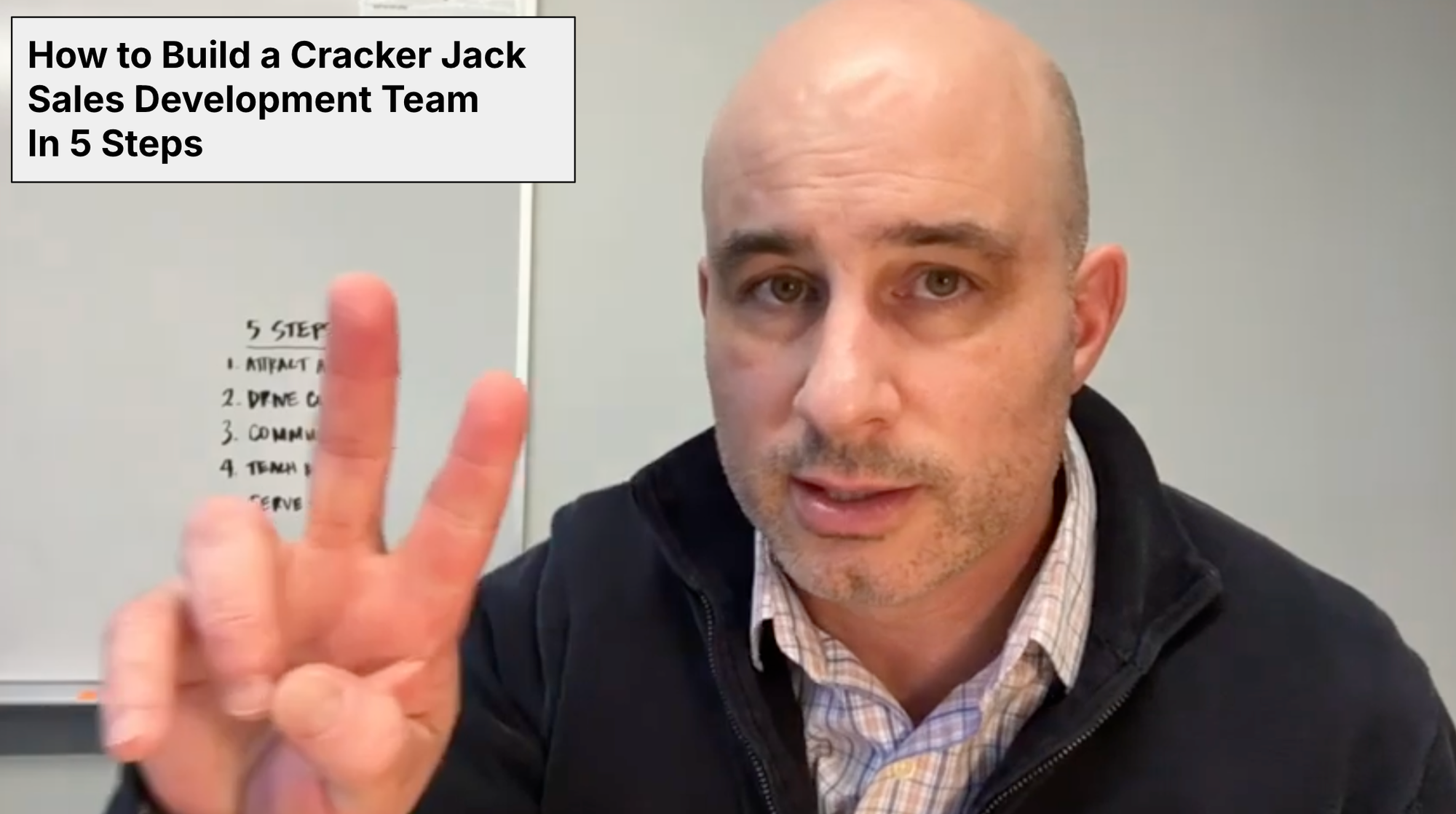
You can see from the whiteboard behind me what it is we're going to talk about in the time that we have together. We don't have too much time, so I'll probably crank through a lot of these topics and I'll drill into a couple bullet points under each topic, but no more than like five bullet points per headline.
The good news is, I'll likely write about this and I'll add a lot more color and context and some annotations and some links, and I'll give you some resources and references to consider if you want to explore any of these five areas even further.
(02:13):
So who am I? I am Ralph Barsi and I oversee the worldwide sales development organization at ServiceNow. We have Account Development Reps or ADRs working at 11 different offices around the world today.
You'll hear the acronym ADR, SDR, BDR, LDR. It's all the same for the most part, and that is sales development rep. But anyway, covering that many different geographic territories requires a mindfulness and understanding that people communicate differently depending on where they are in the world.
They take in information differently. They have different approaches, different cultures, different languages, different styles, and it's imperative that you as the leader understand all those variations and all those differences of your team, whether they are a worldwide team or whether they're just in different phases in their career.
(03:23):
I'm nearing my 25th year in sales. It's why I've got salt and pepper stubble. It's why I have no more hair on my head because 25 years in sales is also no joke, and it's not for the faint of heart either.
But the first half of my career was spent as an individual contributor where I was an account executive. I carried a bag, I held a quota, I owned a territory, and I was responsible for closing deals and bringing in new business over the line for our company.
It served me very well in the latter half of my career, which has really centered on building and leading sales and mostly sales development organizations.
(04:10):
If you lead a sales development organization today and you have not invested time in your career as an individual contributor, do it at your earliest opportunity. Get your team buttoned up, get your team performing. Remember that it's all about systems not goals, so focus on implementing great systems and processes so that you have repeatable results and predictable results, and then get out of that role and start carrying a bag and closing business.
(04:22):
Then if you want to return to sales development in leading an organization, you're going to have a lot more credibility and rapport when you're trying to implement a service level agreement or you're trying to increase the qualification criteria or you are having challenges with the AE-SDR handoff.
For example, the sales organization is going to listen to you a lot more intently if you have walked in their shoes. So enough about that, but get into the field as early as you can.
(05:00):
Okay, so let's talk about how to build a crackerjack sales development team in just five steps. Why did I use the term crackerjack? A lot of you're asking yourself what's up with Barsi using these old school terms. Isn't crackerjack like the box of candied popcorn that I eat? Of course it is, and of course Cracker Jack is not a regularly used term and that's the point. I compelled you to come and watch this session.
You looked twice at the title because you don't see the term cracker jack used very often. I got that whole concept from entrepreneur and digital media expert, Neil Patel. He runs a number of different companies, one being KISSmetrics, another one is Quick Sprout.
And Neil wrote a great step-by-step guide for writing powerful headlines, and the intent when he wrote the step-by-step guide was for bloggers or writers to write powerful headlines to their articles. Well, the same applies to your ADRs writing powerful subject lines in their emails. The same applies to your company, providing a powerful offering to the marketplace so that you can attract more customers, prospects, and suspects into your ecosystem.
(06:26):
And the same applies to you as a sales development leader looking for great people to build a great team with. You need to have a powerful brand and reputation that precedes you in the marketplace.
So when you're not in the room, the right things are being said and thought and talked about when it comes to you. That's why I use the term crackerjack and it segues perfectly into step number one of building a great team, and that is attracting A players.
I think all terms are important in that one line: attract versus pursue and A player, not B player, not C player, not somebody trying to figure out what player they are. Straight up A players.
(07:15):
Let's drill into this. What's really important when you're attracting A players is you have to understand that what you seek is also seeking you. The same applies to people.
You'll often hear the term people don't leave companies, people don't leave their teams, people leave the leader. Well, it's the same reason people join those companies, join those teams and join those leaders. It's because they want to learn from and improve their craft from a certain leader.
(07:35):
So I would implore you to ask yourself how good you are at attracting talent in your organization to begin with. If people are not applying to the job description, for example, that you have posted online, it could be for a couple reasons.
Maybe they don't know who you are. Maybe when they look up who the hiring manager is, that is if they know who the hiring manager is, they're not seeing much. There's nothing compelling them or gravitating them towards the role or towards your team or towards your organization because they can't learn about you, they can't find you.
So make it a point and a priority to get better at building your brand and reputation in the marketplace. So people say, "Hey, I love what she's saying. I love what she just wrote. I saw that video that she did where she was interviewed by so-and-so, and there are three really powerful insights that she articulated in that presentation."
(08:31):
That's the type of person that I want to go learn from and work for. Ask yourself about how good and how strong your brand is in the marketplace.
I am tired of seeing the exact same job description out there when it comes to a sales development role. So do yourself a favor and maybe outsource by using a freelancer through Upwork or another organization and find all, I don't know, the top 50 or 100 sales development job descriptions that are out there. And take a look at the exact same keywords that they're using and the exact same structure and format that these job descriptions are using and do it completely different.
Talk better about the learning opportunity that someone's going to have when they join your organization as a sales development rep. Talk to them about how it's a two-way street. They're going to invest time and energy and effort in finding the best prospects for your account executives and creating the best meetings for your account executives to kickstart a sales cycle with.
(09:46):
And at the same time, the organization is going to invest time, effort, and money and resources in the developing of their careers.
Those are some things that job descriptions need to say that a lot of them just don't say today. You have to think about it as you're casting out a bright bat signal into the sky and you're pulling in the right people to be part of your team.
Think about creating a webpage that is solely dedicated to the sales development organization, and that webpage might include a one-minute video that's popping, that's fast, that includes sales development reps who are currently working in the role today in your organization, talking about what a great place it is to work and how much they're learning and how they feel their careers progressing almost on a quarter-by-quarter basis because of the incredible environment that they're part of.
(10:56):
You might also want to interview former sales development reps who are now successful account executives, so they could talk about the well-lit career path that they learned about when they were interviewing for the sales development role in your organization and how that has come to realization and they're now account executives, individual contributors, closing business, bringing in revenue to grow the company in the marketplace and to grow the company's ecosystem.
All that stuff should be part of the recruiting process, which leads me to another great tidbit about attracting A players: try hosting a two to three hour recruiting or networking event at your company.
These cost nominal amounts of money. I think we've invested to the tune of 500 bucks for some of the recruiting events that we've hosted and we've gotten some of our best candidates from it.
(11:57):
Have your leaders or managers or even the SDRs themselves write a quick little post on LinkedIn and share a URL that invites people to register to attend your networking and recruiting event.
It's basically touted as an informational opportunity for them to come learn about the different people that work there, about the offering, about the different partners that your company might work with, and get an opportunity to really press the flesh and look people in the eyes and learn about the experience of current employees.
It's just an incredible way to meet who's out there. And then another great last tip for attracting A players is to have a compelling employee referral program. The best people come from A players that are already in your organization and on your team, so get more of them.
They know what attributes and characteristics you and your company are looking for. Pay them handsomely to bring those great people in should you hire them. Those are just a couple tidbits on how to attract A players to your organization.
(13:06):
Number two is you got to drive a strong employee culture. We talked about people not leaving companies but leaving leaders. It's the same reason they join, so create an environment where your people are celebrated, not tolerated.
One of the companies that I worked for focused on driving employee engagement in the marketplace, and fortunately more and more companies are latching on to this concept and actually applying it in their teams and in their companies. And that is they're recognizing the great work that their employees are doing on a regular basis.
That is the sense of celebration for somebody's hard work that your employees are going to get every day in the workplace. It might be a two-line email or it might be the next team meeting or all-hands call you recognize the great work that your SDRs or ADRs are getting in the field or from the multitude of stakeholders that they serve on a regular basis, and it might be a recognition that they get from you.
(14:00):
Nonetheless, if you're not recognizing these people, how are they going to know that they're doing great work and how are they going to know that their peers who are getting recognized are setting great examples that they want to follow? These are some things you want to think about when you're recognizing people in the workplace.
A great book that I would give recognition to is called Under the Hood by Stan Slap. He talks about respecting culture, and we've heard so many quotes over the years that culture eats strategy for breakfast.
So what's meant by that is you the leader might have initiatives that you're really fired up about touting with the team and making sure that they fall in line and illustrate on a regular basis. But I'll tell you, if the culture isn't resonating with those initiatives, it's just not going to happen.
(14:52):
So you have to be very aware of what that culture is in the workplace. You have to lead by example and you have to come to terms with yourself and with your team that you're going to raise standards in your organization. And if you will change, everything will change for you.
So if you're not happy with how things are going right now in your culture, for example, you might have a very quiet workplace. So all the SDRs are researching and researching and they're not picking up the phone and they're not emailing prospects and they're not setting meetings because it's like a library.
At the drop of a dime, you need to switch things up. Motion, as you know, causes emotion. So maybe you need to get up and walk around and talk to people about how their day's going and what they have teed up for the day.
(15:44):
You might want to pull everybody into a conference room and go around the room hosting a power hour where everybody on the team gets on the phone with the people that they're trying to reach or the logos that they're trying to engage and watch them leave a voicemail or have a conversation with the prospects and suspects in your marketplace in front of their peers so that you can provide an environment that shares constructive feedback with them and gets them better at their game.
People are the average of who they surround themselves with. A players know this, so they surround themselves with greatness, and you have every power in the world to create an environment of greatness by sitting with your team and hosting something like a power hour.
Lastly, when it comes to driving a strong employee culture means showing them a well-lit career path as we talked about earlier. Make sure that even in the recruiting and hiring process you're talking about and managing expectations for a 15, 18, or even 24 month term as a sales development rep before they become eligible to become account executives or Jedi salespeople in your organization.
(16:57):
Throughout that well-lit career path, you as an organization are sharing certification programs, for example, and certifying your team on how to conduct a great phone call, how to present to people online or face-to-face, small group versus large group, and you're talking about all the different mechanics of your operation on a day-to-day basis so that they are mastering the craft of sales development.
And that's a nice segue into number three. You have to communicate well and communicate often, and you have to teach mastery. So let's talk about that for a minute.
As we learned earlier, people of different organizations come from different walks of life or different parts of the world, and you as a leader have to be fully aware of the different cultures and languages and approaches to sales development in different parts of the world.
(18:13):
So for example, if I want to execute an SLA that asks a sales development rep to apply eight to ten touches against a lead over the course of 20 business days here in the United States, that's par for the course. That's very, very normal. In different parts of the world like Japan or Australia, that doesn't go over very well.
And by you executing eight to ten touches against a lead over the course of 20 business days, through email, through social outreach, through phone calls, through literally knocking on the door of those offices, you risk losing that prospect and that precious logo that's on your target account list for a good 18 to 24 months because you've really rubbed them the wrong way with your eight to ten touch SLA.
So you have to tailor that SLA depending on where you are in the world.
(19:00):
Also, in America, it's very common where we want very short emails because people are reading emails on their mobile devices and you want to maybe have two to three lines with a couple bullet points. You want to ask a question and you're out, or you want to apply the 10-80-10 methodology where it's 10% personal, 80% general, 10% personal again, and you're out. But that email is a paragraph or two long.
Here in the US that goes over just fine. Whereas in parts of Europe, it's almost insulting to them to read an email that's three paragraphs long. So you have to be aware of where you're reaching out to in the world and how they do work in that part of the world before you create a communication.
Also, you have to invest time in your team. When it comes to communicating, that means you have to be hosting a regular one-on-one with your leaders or with your ADRs or SDRs.
(19:24):
That one-on-one has to be consistent. It can't be done once a month. That way, if your company does employee reviews once a year and you've not been doing these one-on-ones, everything comes as a surprise to your SDRs.
So be consistent and host one-on-ones outside more than inside. A lot of people get really turned off by having the laptop up, taking a look at dashboards and metrics and talking about activity levels. When people don't go to work to just go to work, they go to work to become something in the process.
You as a leader, being aware of this and talking about this in their one-on-ones, at least a sliver of the one-on-one being invested on what they're becoming in the process is really, really critical.
(20:16):
Teaching mastery really comes down to teaching your ADRs and your leaders for that matter, to own their business within the business.
So in sales development, it's pretty simple. We do inbound lead follow-up and we do outbound lead qualification or prospecting. Making sure that your team is aware of the investment that marketing is making in pouring leads into the top of the funnel, they have to see a return on that investment. So having an SLA on lead follow-up is critical.
Making sure that we understand the probability and the conversion rate of lead from a specific source closing versus a lead from another source not closing is really important. Teaching the mechanics of inbound lead qualification.
(21:15):
On the outbound prospecting side, it's a lot more effort required and it's a lot tougher to penetrate a precious logo that your company has been trying to engage. That could essentially change the course or the trajectory of your company. It's important that you measure twice and cut once before you pick up the phone and make a call to a C-suite or a VP or director level executive in the organization.
(21:26):
That's what teaching mastery is. Also, if your SDRs are performing well and they earn the right to interview for an account executive role and become an individual contributor, the fundamentals that they learned and that you taught while they were in sales development are going to be drawn upon and referred to when they are account executives.
So for example, if they don't know how to set up their calendar and manage their time well throughout the day, or if they don't understand the deal mechanics of what a sales rep has to go through on a regular basis in working a deal through all stages of the pipeline to closure, they're going to fall on their face very quickly once they are promoted to the individual contributor role.
So it's important to teach a lot of those steps while they are sales development reps so that you can ensure their success when they are individual contributors.
(22:20):
That's how you teach mastery. Lastly, it's all about serving others. In a lot of respects, we liken the sales development function to the knot on a tug-of-war rope in between marketing or in between sales or in between the partner ecosystem and the channel.
There are a lot of different masters that we serve when we are in a sales development function, but the good news is when you're teaching sales development reps to actually serve that marketplace and be people for others, things go along much more smoothly.
We are here to be seen at the bottom of our org chart versus the top. We serve up into the organization so that we can move obstacles out of the way of the paths of our colleagues in marketing and sales and the partners and all the subgroups that fall beneath those.
(23:27):
We serve demand gen, we serve campaign marketers, field marketers, operations and enablement. Within marketing, we also serve sales solutions consultants, customer success managers, and everything in between.
The partners, we have our integrated partners, our integration partners that we work with on a regular basis. We also have a lot of smaller partners in the ecosystem that might register a deal for us to work with them or they want to become part of our portfolio of partners.
There's a lot of different people that sales development reps are usually the ones who are interfacing first with for the company. So it's really important to recognize that we are servants.
And when you've got all five of those working in harmony, you've got yourself a Cracker Jack sales development organization.
(24:10):
Look, I'm mindful of the time. I know I'm running over. I can go for days on this stuff with all of you, so keep an eye out for what I write about with respect to today's talk. I'll go into a lot more detail and share some more action items and books like Stan's that you can buy on Amazon or online or directly from these authors to continue your education process.
Look, as I said at the start of our call or our talk today, it's really been an honor and a privilege being with you today. Enjoy the rest of the sessions with the Sales Development Summit and get in touch with me on LinkedIn or Twitter if I can answer any of your questions directly.
(24:26):
Alright, have a great day and thanks for joining. See you.